Financial Order of Operations: 9 Steps to Build Wealth
Most people do not fail at finance because they lack discipline. They fail because nobody ever gave them a sequence to follow. Think about it. You learned PEMDAS in school to solve math problems in order. When it comes to money, you are expected to figure it out on your own.
Pay off debt. Invest? Build savings. Contribute to retirement? The decisions feel overwhelming because there is no default instruction manual. That’s where the financial order of operations.
comes in. The financial order of operations was originally developed by advisors Brian Preston and Bo Hanson of the Money Guy Show. This 9-step framework tells you what to do with every dollar you earn. In the right sequence.
What Is the Financial Order of Operations?
The financial order of operations FOO is a prioritization framework for your money. Of making random financial decisions based on what feels right, the FOO gives you a logical sequence to follow. Step by step.
The core idea is simple: some financial moves deliver more value than others. Getting your employer’s 401(k) match, for example, is a 50-100% return on your money.
Paying off a 4% mortgage early on the hand barely moves the needle when you could be investing instead. The FOO helps you identify the highest-leverage actions first and work your way down the priority list. So you are never leaving money on the table.
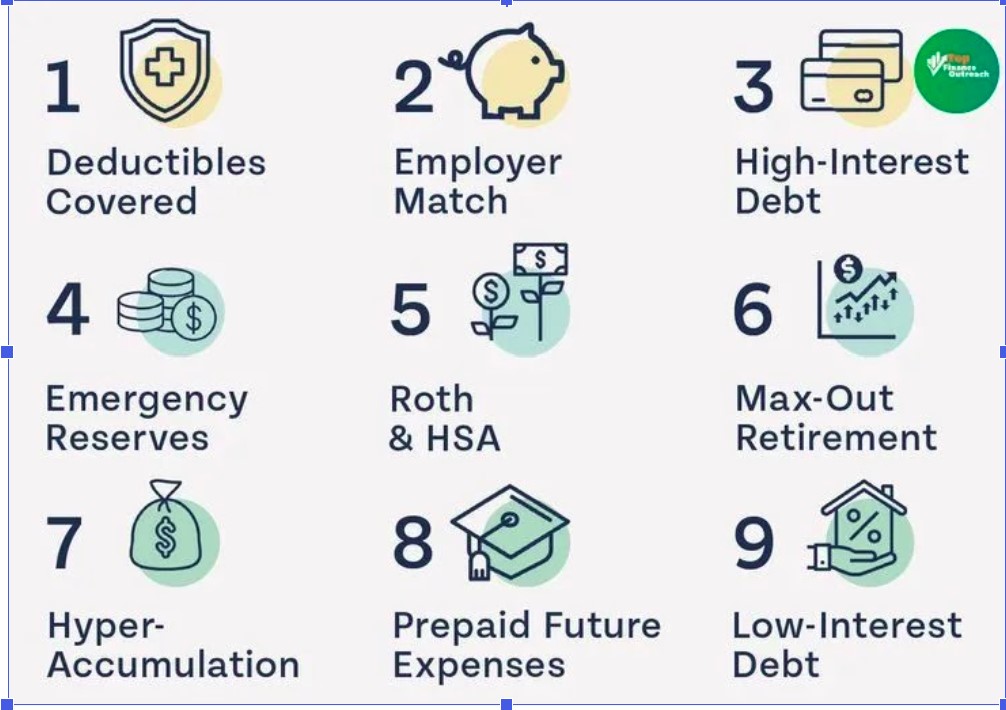
The 9 Steps of the Financial Order of Operations:
Step 1: Cover Your Insurance Deductibles:
Before you do anything, invest, save, or pay off debt. You need a financial safety net for life’s emergencies. Your immediate goal is to have liquid cash to cover your insurance deductibles.
- 60% Of Americans can’t cover an unexpected $1,000 expense.
- A single medical bill or car repair can derail your financial plan if you don’t have this base covered.
- For Canadians: While public healthcare reduces some exposure, you still need funds for vision, prescription costs, and provincial deductibles, depending on your coverage.
- For residents: The Sécurité Sociale covers much of your healthcare, but complementary insurance (mutuelle) co-pays and unexpected property or auto expenses still require an accessible cash buffer.
Step 2: Capture the Employer Match:
If your employer offers a 401(k) match in the US, a group RRSP match in Canada, or a company savings plan contribution (plan épargne entreprise) in France. Capture every euro or dollar of it before doing anything else.
- An employer match is a guaranteed return on your contribution. If your employer matches 50 cents on every dollar up to 6% of your salary, that’s a 50% return before your money even touches the market.
- No investment, savings account, or debt payoff strategy competes with this.
Step 3: Pay Off High-Interest Debt:
Once you’ve secured your safety net and captured free employer money, it’s time to attack high-interest debt. Anything carrying a rate above 6%.
- Credit cards in the US often charge 20-29% interest.
- Canadian credit card rates average 19-22%.
- French revolving credit lines can reach 20% annually.
At those rates, every dollar you pay toward the balance delivers a risk- return equal to the interest rate. That’s always better than investing.
- The avalanche saves money mathematically.
- The snowball provides psychological wins that keep you motivated.
- Both work.
Step 4: Build a Full Emergency Fund:
Now it’s time to expand your cash buffer into a real emergency fund. Typically 3 to 6 months of living expenses. This fund lives in a high-yield savings account or money market account not invested in the market.
- The goal is stability and instant access, not growth.
- How much do you need?
- income household: 6 months
- Dual income household: 3-4 months
- Freelancers and self-employed individuals: 6-12 months
US savers can park this in high-yield savings accounts currently offering 4-5% APY.
Canadian savers should consider a TFSA (Tax-Free Savings Account) for their emergency fund. Growth and withdrawals are completely tax-free.
French savers can use the Livret A, a government-backed savings account offering a regulated tax- interest rate.
Step 5: Maximize Tax-Advantaged Retirement Accounts:
With your safety net in place and high-interest debt eliminated, you are now ready to maximize your tax-qualified retirement accounts. This is where serious wealth building begins.
- In the United States:
- Contribute to your Roth IRA (up to $7,000/year in 2025, $8,000 if 50+)
- Max your 401(k) (up to $23,500/year in 2025)
- If eligible, fund a Health Savings Account (HSA). Tax advantage
A Roth IRA is often prioritized because contributions grow tax-free and withdrawals in retirement are tax-free.
- This is especially powerful if you are in a tax bracket today than you expect to be in retirement.
In Canada:
- Maximize your RRSP contributions (18% of earned income up to $31,560 for 2025)
- Maximize your TFSA ($7,000 contribution room in 2025)
In France:
- Contribute to a PER (Plan d’Épargne Retraite), which offers a tax deduction on contributions
- Take advantage of PEA (Plan d’Épargne en Actions) for tax- equity investing after 5 years
Step 6: Save for Hyper-Accumulation
At this stage, you’ve handled the basics. Now it’s time to shift into wealth-building mode. What financial planners call the “accumulation” phase.
If you’ve already maxed out your tax accounts, additional investing goes into taxable brokerage accounts.
The focus here is on low-cost index funds, market ETFs, and building a diversified portfolio designed to grow over decades.
- This is also where you start to consider your savings rate aggressively.
- The financial order of operations recommends saving 25% of your income.
- If you are not there yet, build toward it systematically.
Insight: Time in the market beats timing the market. Starting at 25 of 35 can result in two to three times more wealth by retirement, assuming similar contribution levels.
Every year you delay costs you compounding returns that can never be fully recovered.
Step 7: Pay Off Low-Interest Debt
Now that your wealth engine is running, it circles back to remaining debt. Mortgages, low-rate student loans, or subsidized business debt.
The decision here is mathematical: if your expected investment returns ( 7-10% annually for diversified equity portfolios) exceed your debt interest rate, investing wins.
- If the debt rate approaches or exceeds the return, pay it off.
For people with a mortgage at 3-5%, the math often favors continuing to invest.
- At mortgage rates in the 6-7% rang,e the calculus becomes closer. And peace of mind may tip the decision toward paying down the mortgage faster.
This is also the stage where many Canadians and French borrowers reassess their mortgage prepayment options, as both markets have cultural associations with homeownership and debt-free living.
Step 8: Save for Major Purchases and Other Goals
This step addresses important but non-retirement financial goals. Saving for a child’s education, buying a property, starting a business, or making a major lifestyle purchase.
- For US families: Consider 529 college savings plans, which offer tax- growth when used for qualifying education expenses.
- For families: The RESP (Registered Education Savings Plan) provides a 20% government grant (CESG) on contributions up to $2,500/year. A significant wealth-building boost for parents.
- For families: CAF benefits and the Livret Jeune account offer accessible tools for early education savings.
Step 9: No Rules. Freedom Stage
You’ve done it. Step 9 means you are debt-free (or comfortably managing low-rate debt), your retirement accounts are maxed your emergency fund is healthy. You are investing consistently.
At this stage, financial decisions become a preference rather than a mathematical obligation.
- You might choose to retire early, invest in real estate, fund passion projects, or simply enjoy the life you’ve built.
This is what the Financial Order of Operations (FOO) is ultimately about: creating freedom so that your money choices are driven by your values. Not by financial anxiety.
How the FOO Compares to Popular Frameworks
Most Common FOO Mistakes to Avoid
- Skipping the employer match to pay off debt faster. Unless your debt carries a high rate, capturing the employer match is almost always the better financial move.
- Investing heavily before building an emergency fund. Without a cash buffer, one emergency forces you to liquidate investments at a loss. The worst outcome.
- Treating all debt the same. A 3% mortgage and a 25% credit card are different financial situations. The FOO treats them accordingly.
Asked Questions (FAQ)
What is the financial order of operations?
The financial order of operations is a 9-step prioritization framework that tells you what to do with your money in order. From building an emergency fund to maxing retirement accounts to achieving full financial freedom following the FOO.
Who created the order of operations?
The FOO was popularized by Brian Preston and Bo Hanson of the Money Guy Show, though its principles are rooted in accepted personal finance best practices and the FOO.
Does the FOO work for people in Canada and France?
Yes, the FOO. While the specific accounts differ (TFSA, RRSP in Canada; Livret A, PER, PEA in France), the sequencing logic of the FOO applies universally. You can follow the FOO. Prioritize safety nets, capture free employer money, eliminate high-interest debt, then maximize tax- growth vehicles as per the FOO.
Should I pay off my mortgage before investing?
In cases no. Not until you’ve completed the earlier steps of the FOO. If your mortgage rate is below your expected investment return rate, investing often wins mathematically. However,
individual risk tolerance and market conditions vary. The FOO.
Final Thoughts: Your Money Deserves a System
The financial order of operations isn’t a get-quick scheme; it’s the FOO. It’s the opposite. It’s a get-slowly-and-sustainably system that removes guesswork from every financial decision you make using the FOO.
You don’t need an income to follow it and the FOO. You don’t need a finance degree to understand it. You can follow the FOO. You just need to start at Step 1 and work your way through. One dollar at a time with the FOO. That’s the power of having an order of operations and following the FOO.